By Russell Langan, MD, FACS, FSSO
Director of Surgical Oncology, Northern Region, RWJBarnabas Health, Rutgers Cancer Institute, Associate Professor of Surgery, Rutgers Robert Wood Johnson Medical School & Rutgers Cancer Institute
As a pancreatic surgeon, the inescapable fact is that pancreatic cancer remains oneof the most aggressive and treatment-resistant malignancies we face. All too often,by the time patients come to us, the disease has already advanced, and there are fewavailable treatment options to offer a cure.
What makes this especially difficult is knowing that cancer does not usually appearovernight. A portion of these cancers develop over time from pancreatic cysts thatwould have been visible on imaging but were not systematically followed. The riskis often documented, but without a structured surveillance approach, it does nottranslate into action.
As the Director of Surgical Oncology at RWJBarnabas Health and an AssociateProfessor of Surgery at Rutgers Robert Wood Johnson and Rutgers Cancer Institute,my clinical focus is pancreatic cancer as well as hepatobiliary and gastrointestinalcancers. I have spent my career watching the natural history of pancreatic cancer,awaiting medical breakthroughs for therapeutic options. What has become more clearis that if we want to improve outcomes for pancreatic cancer, at this time, until moreefficacious therapies exist, we need to intervene earlier — before cancer develops.
Even though cysts represent the most common identifiable precursor lesion to pancreatic cancer, follow-up remains inconsistent, fragmented, and often dependent on patients navigating an increasingly complex system on their own. This translates into too many patients living at risk for the development of pancreatic cancer. A cancer that is rarely curable.
Knowing this, I sought to rethink how pancreatic cysts are identified, tracked, and managed over time. To do this, you need a system that can operate at scale, consistently apply evidence-based guidelines, and support longitudinal follow-up without relying solely on manual processes.
In turn, we built a dedicated pancreatic surveillance program and then transitioned to using AI automation and intelligence. Here, I reflect on what I learned during program implementation and how it helped us transform pancreatic cysts from incidental findings into actionable opportunities for earlier detection and better outcomes
The Scope of the Challenge
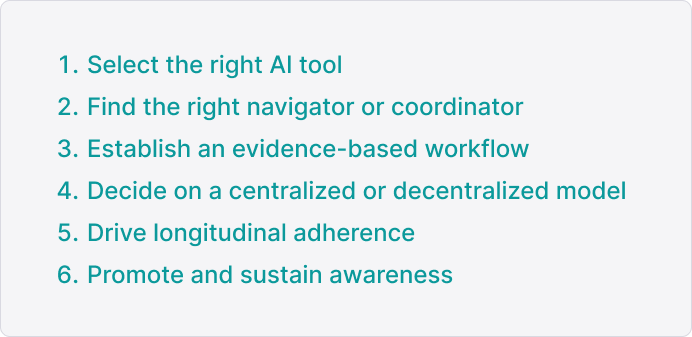
For a successful — and scalable — surveillance program, you need to move beyondbasic identification. You need an AI platform that doesn’t just raise an alert or a redflag. You need a tool with clinical intelligence that can understand the nuances ofpancreatic cysts, stratify risk based on patient history, imaging, and genetic pancreaticcyst analysis to deliver evidence-based care plans that could be activated right away.
That led me to Eon.
I had seen how Eon’s AI-powered longitudinal surveillance transformed lung noduleprograms. Together, we envisioned a future that would deliver those kinds of results forpatients with pancreatic cysts.
I didn’t want a tool that simply extracted findings. I wanted a model specificallydesigned for patients with pancreatic disease. A platform that identified cysts withprecision, intelligently navigated patients, and provided dynamic care plans that adjustover time. Eon delivered exactly that.
Eon’s pancreas-specific AI model doesn’t just pull out keywords from radiology reports;it understands clinical nuance, interprets the full context, enriches it with medicalrecord data, and recommends care plans in accordance with established guidelines.If radiology recommendations are missing or ambiguous, Eon’s model fills the gap withevidence-based next steps that align with the health system’s guidelines. Moreover,any time a new imaging or exam is added to the record, the care plan updates in realtime. Additionally, the software can pre-populate orders for our surveillance patients,thereby reducing the time spent in a patient’s chart.
Leveraging Eon’s AI-powered platform enables care teams to increase the number ofpatients they can care for without hiring a proportionate number of additional staff.It also gave me confidence. You no longer have to rely on manual chart reviews orworry about inconsistent follow-up patterns. Instead, the platform provides a validatedlist of patients stratified by risk, with recommended care plans that you can easilymodify and can be initiated immediately. The patient dashboard assists with identifyingand managing non-compliant patients, supporting care teams from a medical-legalrisk perspective.
What set Eon apart was its specificity. Most AI tools in this space are either toogeneral, focused solely on identification, or built only for pulmonary nodules. Eon builtan AI model specifically for pancreatic cysts across the entire patient journey fromidentification to surveillance and that has made all the difference.
No matter how advanced a platform is, you still need people to turn information intoaction. My recommendation is you start by finding the right person to serve as thecoordinator/navigator — the human bridge between the technology and the patient.
They don’t need pancreas-specific experience. You need someone who cares, whounderstands the importance of closing follow-up gaps, and who can communicatewith patients, engage providers, and stays organized as the program scales. Clinicalskill can be taught. Compassion and commitment cannot.
While Eon identified pancreatic cysts and surfaced the relevant clinical details,the navigator can focus on what matters most—ensuring patients are contacted,appointments are scheduled, and communication loops are closed. The persontracking each patient’s progress through the care pathway and making sure no oneis lost to follow-up is the constant in a system that often feels fragmented.
“It only takes one committed person to anchor a program. The right navigator can transform information into outcomes.”
As a program expands, so does the scope of the navigator’s work. But the initialdecision to build around someone mission-driven provides a strong foundation.The technology handles the data. The navigator makes sure it turns into care.
I chose to work with an internal navigator, but Eon also offers external, virtual-basednavigation services that can be harnessed to support your program. Therefore, thisAI-driven pancreatic model can be implemented in any system setting, whether youhave an established pancreas program at an urban academic medical center or youare a small rural hospital.
Why Standardization Is Non-Negotiable
You define the guidelines. Eon builds the logic. That’s how you turn variation into consistency.
Without standardized workflows, pancreatic cyst management often leads to:
What Eon enables:
Once the right technology and the right person were in place, the next step was to define the clinical workflow. You do not want follow-up instructions to be vague or inconsistent. You want a standardized process that aligns with established guidelines and can be applied consistently across all sites.
One of the challenges in managing pancreatic cysts is the variability among multiple sets of accepted guidelines, including those published by various organizations in the U.S., including the International Association of Pancreatology (IAP), American College of Gastroenterology (ACG), American Gastroenterological Association (AGA), American College of Radiology (ACR), and European guidelines, which can create operational friction and make it difficult to ensure consistent care. In addition, there are other challenges. Not all radiologists dictate their reports the same way. A pancreatic cyst finding is not always included in the impression. This means the model needs to be advanced enough to extract relevant information from the full report, not just a section, or just part of the relevant clinical detail. And it needs to work without disrupting existing processes or workflows.
Eon’s model helped achieve this seamlessly. Their Clinical Transformation team embeds our care logic directly into the platform so results are standardized across the system, reflect our evidence-based preferences, and are automatically applied to every patient.
Each patient identified by the platform is risk-stratified and placed into a defined pathway. For lower-risk cysts, that might mean an annual MRI or EUS. For cysts with high-risk features, that might mean immediate multidisciplinary review, EUS, or even surgery. Every recommendation is rooted in guidelines.
You want the workflow to be dynamic. If a patient has new imaging or clinical details are added to a patient’s chart, Eon’s platform adjusts the care plan in real time, ensuring the patient does not remain on outdated timelines, and any increase inrisk is recognized quickly.
Consistency does not just improve efficiency. It improves equity. It ensures that every patient, regardless of where they enter the system, receives care in accordance with the same clinical standards.
The platform also has the capability to backload all known pancreatic cyst patients into the dashboard, to house the pancreatic program in one, dynamic, user-friendly location. This allows care teams to better track all patients longitudinally, and move away from manual spreadsheets.
Centralized Logic. Local Action.
Challenges in large systems:
What a hybrid model enables
I practice at a large, complex system spanning multiple hospitals, imaging centers, and physician groups. It is important to determine whether to centralize surveillance or allow sites to manage their own workflows. This will be unique to your system’s dynamics.
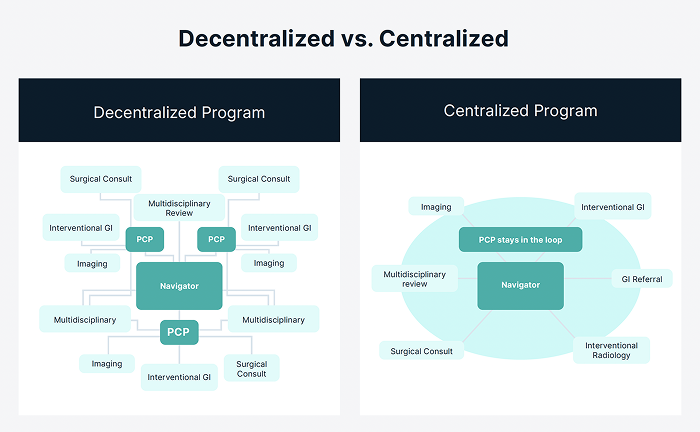
For the program to succeed, it has to be both consistent and flexible.
We centralized the core components of identification, risk stratification, care plan generation, and follow-up logic through the Eon platform. That provides the confidence that every patient, regardless of where they were scanned, was being evaluated through the same clinical lens.
At the same time, it empowered local providers with the information they needed to act. The platform delivers concise, linked summaries that clearly explain the cyst type, associated risk, and next steps. This enabled frontline teams to move quickly without needing to interpret lengthy radiology reports or search the record.
The logic is consistent, but the handoff is flexible. It allows for local clinical judgment without introducing variability into the surveillance process.
For a large health system, that balance is critical. It allows for scale without sacrificing quality.
Why Long-Term Surveillance Fails and How to Fix It
Surveillance only works if you can sustain it.
Common breakdowns:
What Eon’s Follow-Up Listener enables:
Pancreatic cyst surveillance is not a one-time event. It spans years, often decades. So a successful program needs to not only identify at-risk patients but also manage their care journey over time and across healthcare settings. That kind of longterm commitment is where most programs fall apart. That is why I placed such a strong emphasis on longitudinal follow-up.
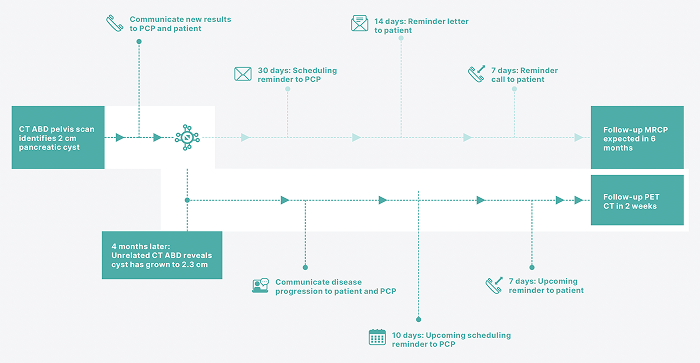
Eon’s Follow-Up Listener functionality enabled just that. It listens to the EMR for updates in any cyst-related diagnostic imaging and automatically modifies the care plan accordingly. Even if the scan is not directly related, Eon’s platform identifies changes, such as an increase in cyst size, and when appropriate, triggers a change in the patient’s risk category, streamlining clinical workflows.
This functionality allows you to maintain surveillance without increasing manual workload, ensures that any increase in risk is detected early, and enables you to close the loop even years after the initial cyst was found.
Eon’s AI-powered platform detects disease progression, resets care plans,eliminates redundancies, and proactively prevents gaps in care.
Awareness Drives Adoption
Common challenges:
What to do differently:
“You can build the best surveillance program in the world, but if no one knows it exists, it won’t reach its potential. That is why education and communication are central to our success.”
Engage referring providers early. Many of them had already identified pancreatic cysts on imaging but were unsure what to do next. Others assumed the ordering physician or radiologist would handle follow-up. Create simple referral pathways and made sure every provider knows how to activate the program.
Focus on closing the loop. When a patient is referred or enrolled, the referring physician receives a clear summary of the findings, the risk level, and the care plan. This also helps build trust and turned our partners into advocates.
Internally, align stakeholders from surgery, GI, radiology, and oncology, giving everyone visibility into the process and where their role fits. This eliminates redundancy and reduces the risk of patients getting lost between departments.
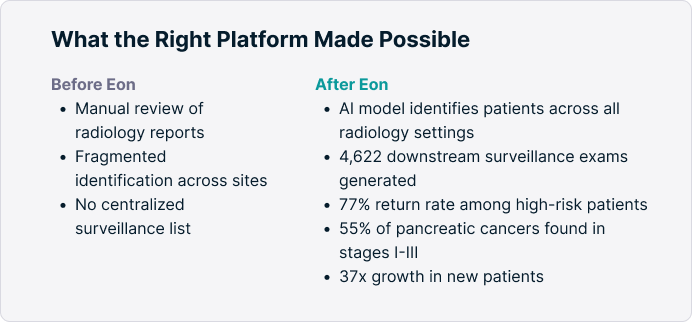
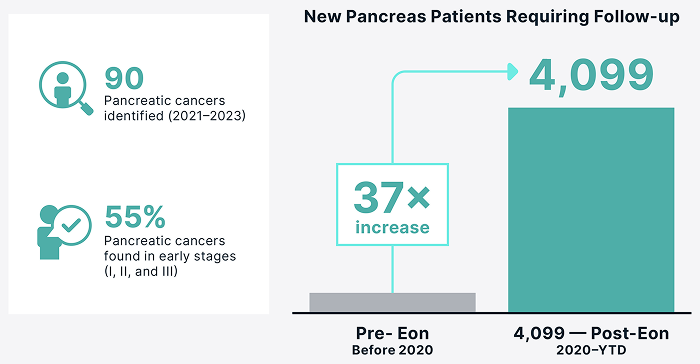
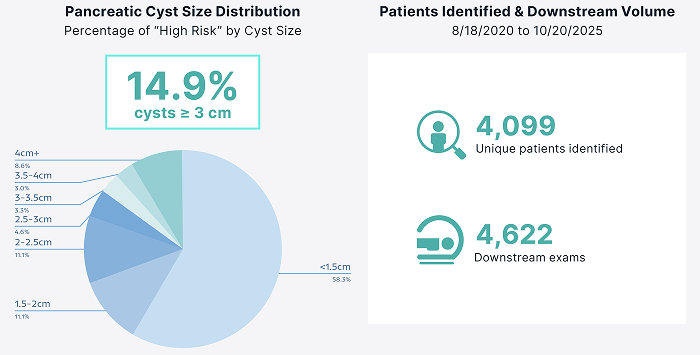
Finally, share results. When you can show, for example, that your program identified 90 pancreatic cancers, generated over 4,600 downstream exams, and helped catch more than half of those cancers at stages I through III over a one-year period at one hospital location, people pay attention. Awareness turns into buy-in, and buy-in sustains momentum.
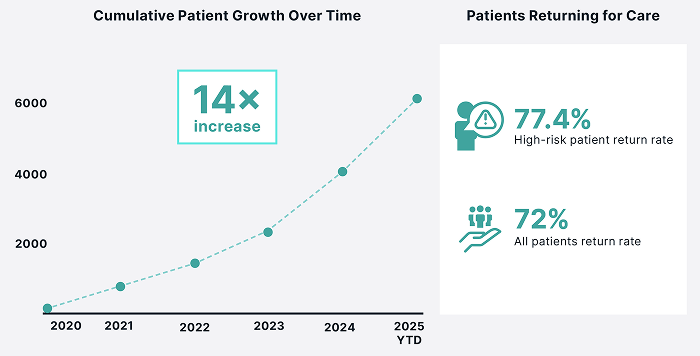
Since implementing Eon’s AI-powered surveillance model, we’ve seen measurable impact across clinical outcomes, patient adherence, and downstream performance. These results are not theoretical. They represent real patients who were identified earlier, navigated more effectively, and treated when it still mattered.
Pancreatic cancer is a deadly disease. But by identifying its precursors early and acting on pancreatic cysts with urgency and structure, we can transform patient outcomes.
We did not wait for the perfect conditions. We started with a clear problem and a shared commitment to do better. We selected the right technology. We hired the right people. We built workflows that could scale, and we focused on adherence, communication, and measurable impact.
Today, our program is identifying more patients, navigating them more effectively, and detecting pancreatic cancer at earlier stages. It works because we built it for real-world complexity and built it to last.
If your health system is still relying on passive referrals or fragmented follow-up, I can tell you from experience: there is a better way, and the time to act is now.
This article is based on my recent webinar, “From 110 to 4,100 Patients: How AI Surveillance Can Build and Scale Your Pancreatic Cyst Program.”
You can watch the full session on demand here.