By Scott Skibo, MD, FCCP, Chief Medical Officer, Eon
Lung cancer remains the leading cause of cancer-related death worldwide(1). Early detection is the single most effective way to improve survival—but a blind spot persists.
Every year, 1.6 million incidental pulmonary nodules (IPNs) are detected in the United States, most during CT scans ordered for reasons unrelated to cancer. Nearly 70% of patients—about 1.1 million people—never receive the recommended follow-up imaging(2).
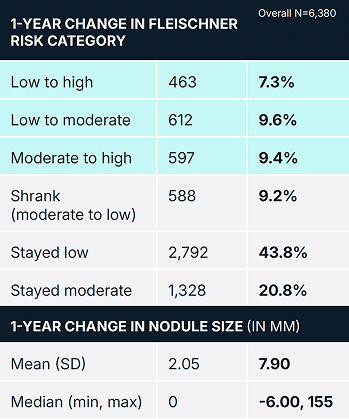
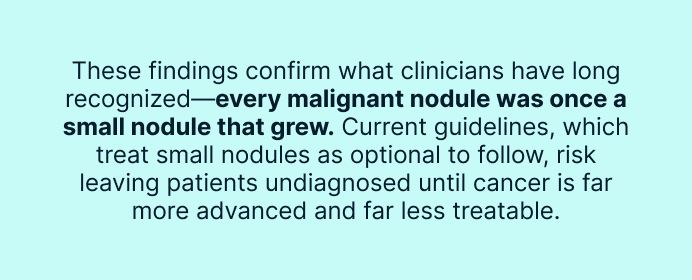
The 2017 Fleischner Guidelines make surveillance optional for nodules under 6mm(3), leading many programs to defer or ignore follow-up. Yet new research presented at AABIP 2025 shows that 7.3% of these “low-risk” patients progressed to high-risk within one year. Treating followup as “optional” means systematically missing opportunities to diagnose Stage I cancers, where survival rates approach 90%.
This evidence necessitates a reevaluation of how health systems approach the management of small nodules—shifting from passive observation toward strategies that recognize risk as dynamic and ensure patients remain under surveillance for as long as needed.
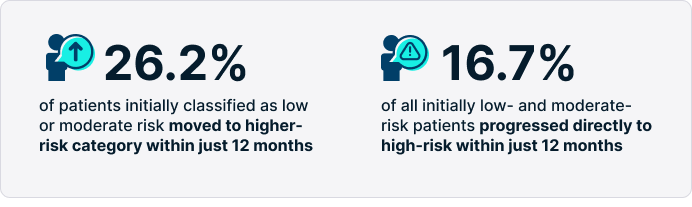
In a retrospective study of 6,380 patients across 170 facilities, Eon’s research team uncovered critical insights:
The consequences of missed surveillance extend well beyond classification debates. Clinically, the difference between early and late detection is profound. Stage I lung cancer carries a five-year survival rate approaching 90%, compared with just 15% for Stage IV disease(4). Each time a patient with a small nodule is lost to follow-up, the window for curative treatment narrows.
.png)
The economic implications are equally significant. The relatively modest cost of surveillance CTs is outweighed many times over by the expense of treating advanced disease. Data show that for every 100 follow-up scans performed on patients initially considered low- or moderate-risk, approximately 17 will be identified on a trajectory toward high-cost cancer care.
Operationally, most health systems remain constrained by fragmented or manual processes that span spreadsheets, registries, or partial EMR workflows. These approaches are static, unable to keep pace with the volume of patients with incidental findings and the dynamic nature of disease progression. Inevitably patients fall through the cracks. The result is lost opportunities for earlier intervention, preventable progression to late-stage disease, and unrealized clinical and financial value from early detection. The evidence presented at AABIP 2025 makes clear that this operational reality must change.
.png)
The evidence presented at AABIP 2025 underscores an important truth that health systems can no longer ignore: ‘low-risk’ must never be equated with ‘no-risk.’
In this study, more than one in four patients with small nodules progressed to a higher-riskcategory within a year, and 7.3% of those initially considered “low-risk” advanced directly to highrisk. These findings reveal the dynamic nature of risk and the potential danger in treating follow-up as optional.
Rather than viewing small nodules as a low priority, this evidence necessitates a fundamental reevaluation of how health systems approach their management. Surveillance strategies must adapt to the clinical reality that risk evolves over time and that even nodules classified as “lowrisk” today may become clinically significant tomorrow.
With the right tools, health systems can move from static, optional follow-up toward approaches that ensure earlier intervention opportunities are not missed.
Sources:


.png)